
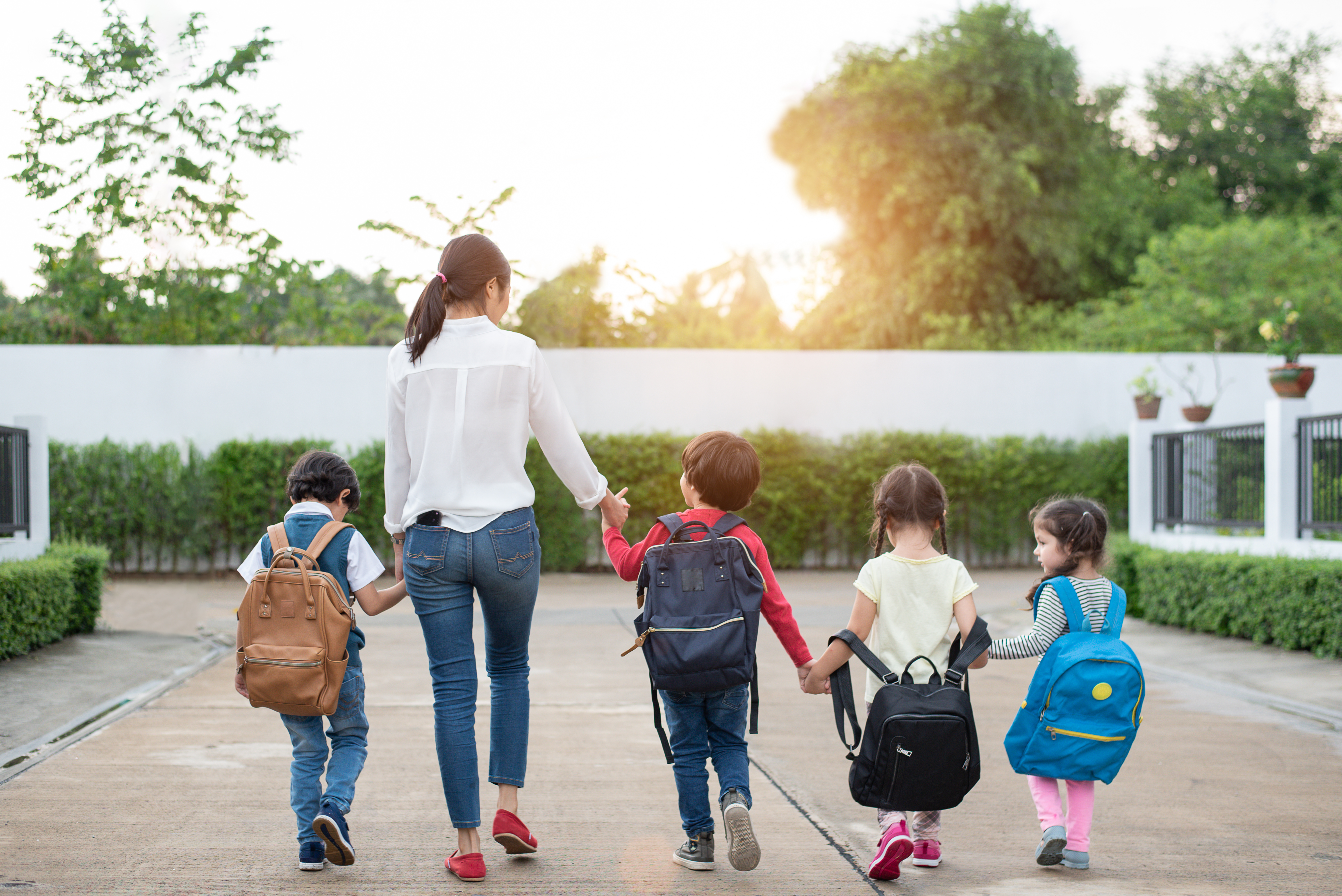
Kids who are starting school for the first time or moving to a new school have to cope with the biggest adjustment, of course. But all children will feel some excitement and maybe anxiety about moving up a grade, a new teacher, a changing social circle, and facing more academic demands. Even kids who are homeschooled often begin new programs when the new school year begins.
The good news is that a little bit of preparation and forethought – a very little bit, so you can enjoy these last weeks of summer!--can make those first weeks of school easier for your kids – and yourself.
Here’s how:
1. Begin talking with your child about what they can look forward to when school begins.
You might start with "We have a few more weeks to really enjoy summer, and then we get to prepare for your new school year. How are you feeling about school starting?"
When you talk with your child, remember that your most important job is to listen. Children, like the rest of us, need to express their worries and frustrations to a compassionate listener, even when there are no good solutions to what's bothering them.
So if your child expresses some discomfort, you might say:
"You're worried about that, huh? Tell me more. What's the worst thing about that?"
You are not trying to talk your child out of their concern. You are a safe place for them to bring their worries to light, which often makes the worry melt away. It's good, though, to ask your child how they think they might handle it, if the worry does come to pass. Your goal is always to help your child discover their own inner resources, and to help them remember that they have access to outer resources that will be easily available to help them. They will not be left alone to cope with what they're worried about. If it happens, they will handle it, or they will get help to handle it.
2. Make sure your child is familiar with the school.
If she was at the same school in the past, great! You only need to talk about any differences this year.
- “Now that you’re in first grade, you get to play on the big kids playground, and go eat in the lunchroom with the other kids.”
- “Now that you’ll be in third grade, you’ll have homework every day.”
- “Now that you’ll be in middle school, you’ll be walking by yourself. We’ll need to practice crossing Main Street.”
But if this is her first year at this school, then you’ll want to take some trips there. Even if there is a formal orientation day just before school begins, start now by taking a trip to the school. If you can get access to the playground, that’s a terrific way to help your child bond with her new school. If not, at least admire it through the fence and get her excited about the slide or climbing structure.
If the building is open, by all means walk in together to check it out. If you’re allowed to poke your head in the library, peer into a classroom or two, and use the bathroom (important in making her feel more secure there) you’ve hit the jackpot. You may not get much further than the office, where you can explain that your child will be starting school in the fall and wanted to see what the school was like, and introduce her to the front office staff. Either way, the more your child sees of the school, the less she’ll fret with fear of the unknown, and the more comfortable she’ll feel on the first day.
3. Take advantage of any orientation opportunities.
Many schools let new students, especially in the younger grades, come to school for an orientation session before school begins. If the school doesn’t have such a program, ask if you and your child can come by to meet the new teacher for a few minutes a day or so before school starts. Teachers are busy preparing their rooms and materials at that time, but any experienced teacher is happy to take a few minutes to meet a new student and make him feel comfortable, since she knows that helps her students settle into the school year.
4. Facilitate your child’s bonding with the teacher.
All kids need to feel connected to their teacher to feel comfortable in the classroom. Until they do, they are not ready to learn. Experienced teachers know this, and “collect” their students emotionally at the start of the school year. Obviously, if you can arrange for your child to meet the teacher in advance, by all means do so. But there are lots of ways to help your child feel like he knows a teacher even if he’s never met them.
Once you find out your child’s classroom assignment, begin talking about the teacher in fond and familiar terms.
- “When you’re in Ms. Williams class, I bet she’ll be impressed with what a great cleaner-upper you are.”
- “I’m pretty sure that Ms. Williams reads stories to the kids; she might read your favorite book if we bring it to school.”
If you can find a photo of Ms. Williams, by all means put it up on your refrigerator and speak to it fondly
“Ms. Williams, you are a great kindergarten teacher and I just know you and my David are going to love each other!”
If you know other kids who have been in Ms. Williams’ class, ask them to tell your child what their favorite thing was about her.
Encourage your child to draw a picture to bring Ms. Williams on the first day, and to pick out a shiny red apple or a jar of flowers for her. Note that it doesn’t really matter what kind of teacher Ms. Williams is. Your warmth toward her will help your child feel a fondness for her, and she is likely to respond favorably. Regardless, the feeling of familiarity will help your child bond with her.
If you notice in the first week of school that your child doesn’t seem to have connected with his teacher, don’t hesitate to immediately contact the teacher. Just explain that your child was excited before school started but doesn’t seem to have settled in yet. You’re hoping that the teacher can make a special effort to reach out to him so he connects with her and feels at home. Virtually all teachers understand this issue and will pay extra attention to your child during that first week if you make a nice request. My own daughter cried every day at the start of fourth grade until I had a conversation with the teacher; a week later she loved him and couldn’t wait to go to school in the morning.
5. Facilitate bonding with the other kids.
Kids are always nervous about their new teacher, but if they know any of the other kids, they’ll feel more at ease. If you’re new in town, make a special effort to meet other kids in the neighborhood. Often schools are willing to introduce new families to each other, allowing kids to connect with other new students in the weeks before school starts. Even if your child is not new to the school, find out which other kids are in her class and arrange a playdate so that she’ll feel more connected if she hasn’t seen these kids all summer. If you can arrange for your son or daughter to travel to school that first morning with a child he or she knows, even if they aren’t in the same classroom, it will ease last minute jitters.
6. Practice saying goodbye.
For many children, the biggest challenge will be saying goodbye to you. Orchestrate small separations to practice saying goodbye, and develop a parting routine, such as a hug and a saying like:
“I love you, you love me, have a great day and I’ll see you at 3!”
You might give your child a token to hold on to that reminds her of you, such as a cut-out heart with a love note, your scarf, or a small stone you found on the beach together, that she can keep in her pocket while you’re apart and give back upon your return. Most kids like to have a picture of the family in their backpacks. Be sure to use the suggestions above for helping her bond with her new teacher; she needs to transfer her attachment focus from you to the teacher if she is to successfully let you go and settle into learning.
7. Ask the school whether you will be able to walk your child into the classroom and hand him off to the teacher.
Find out how long you will be able to stay. If you suspect that your child might have a hard time saying goodbye, by all means speak with the teacher now and make a plan for how to handle the first day. Maybe every morning you will read your child one story and then take her over to the teacher when you say goodbye, so the teacher can comfort and distract her.
Once you have a plan, begin describing to your child what will happen at school. But don’t emphasize the goodbye, keep right on going with how fun the day will be:
“Every morning you will pick a book for me to read to you. When we finish the story, we will find Ms. Williams together. We’ll give each other a big hug and say our special goodbye. Then Ms. Williams will hold your hand and take you to the block corner where you and Michael can build a tall tower while I go to work. You will have snack, and play outside, and read stories, and have lunch. Every day when I pick you up I will be excited to hear what you built in the block corner that day.”
8. Start conversations about the next grade at school or about beginning school.
One good way to do this is to select books relating to that grade. Your librarian can be helpful; some good choices include books by Alan & Janet Ahlberg, Stan & Jan Berenstain, Dianne Blomberg, Marc Brown, Lauren Child, Julie Danneberg, Bonnie Graves, James Howe, Beth Norling, Marisabina Russo, and Amy Schwartz.
Get your child excited by talking about what they can expect, including snack, playground, reading, computers, singing and art. If you know other children who will be in his class or in the school, be sure to mention that he will see or play with them. Share your own stories about things you loved about school.
Encourage her questions by asking what she thinks school will be like. That will help her to express any fears she hasn't articulated, but that are making her nervous. Emphasize the things you think she’ll enjoy but be sure not to minimize her fears; kids can be stricken by worries that adults might find silly, like finding the bathroom at school. Normalize any fears and reassure her that she will have fun, that the school can reach you if necessary, and that your love is always with her even when you aren’t. Be sure to end every conversation with “and when school is over I will be there to pick you up and we’ll have a special snack while you tell me all about your day” so that every time your child thinks about school, she remembers this reassurance.
9. Play with your child to work through fears.
When you're with your child at home, you try not to distract your child from big emotions; instead you welcome the feelings so your child can experience and move through them. But when you won't be there for your child, distraction is healthier. Your child doesn't yet know this teacher and a teacher who is responsible for other kids can't be fully present to help your child through their upset. So work through any tears and fears that your child has about school by playing "school" with your child at home. Get them laughing to dispel anxiety. Then, when you're getting ready for school and moving toward your goodbye, engage your child's "thinking brain" by reviewing what they're looking forward to.
10. If a younger sibling will be at home with you
If a younger sibling will be at home with you, be sure your child knows how boring it will be at home and how jealous you and the younger sibling are that you don’t get to go to school like a big kid. Explain that every day after school you will have special time with your big girl to hear all about her day and have a snack together.
11. Get your child back on an early-to-bed schedule well before school starts.
Most kids begin staying up late in the summer months. But if you have to wake your child for school in the morning, then your child has not had enough sleep. Children need 9 1/2 to 11 hours of sleep a night, depending on their age and individual physiology. (Teens need a minimum of 9.5 hours; toddlers usually do best with 11 hours). Getting kids back on schedule so they’re sound asleep by 9pm, so they can wake by themselves at 7am for school, takes a couple of weeks of gradually moving the bedtime earlier.
Imposing an early bedtime cold turkey the night before school starts results in a child who simply isn’t ready for an earlier bedtime, having slept in that morning and with the night-before-school jitters. In that situation, you can expect everyone’s anxiety to escalate. So keep an eye on the calendar and start moving bedtime a bit earlier every night by having kids read in bed for an hour before lights out, which is also good for their reading skills.
12. Wake up your child’s brain.
You aren’t the teacher, and you don’t need to start school before the school year starts by pulling out the flashcards or assigning math problems. On the other hand, research shows that kids forget a lot during the summer. (Don't worry, they learn a lot from playing, too!) If your child has been reading through the summer months, congratulations! If not, this is the time to start. Visit the library and let him pick some books he’ll enjoy. Introduce the idea that for the rest of the summer everyone in the family (you can include yourself if you like, or you can read to them) will read for an hour every day.
And if your child has assignments to complete, don’t wait for him to remember the day before school starts that he was supposed to write a book report. Finish summer work at least a week before school starts, so he can relax without anxiety for the rest of vacation.
13. Let your child choose his own school supplies...
...whether from around your house or from the store, and ready them in his backpack or bag.
14. The day before school starts, talk about exactly what will happen the next day...
...to give your child a comfortable mental movie:
“We’ll get up early tomorrow for your first day in Ms. Williams’ class. We will drive there together and I will take you into her classroom and introduce you to her. She will make sure you know all the other kids, because they will be your new friends. I will read a book to you and then we will hug and say our special goodbye. Then Ms. Williams will take you to the block corner so you can build a tower. Ms. Williams will show you where the bathroom is, and you can ask her anytime you need to go. There will be games and books and blocks, and she will read to the class. You will get to have fun on the playground with the other kids, and you will get to sit at a desk like the big kids. And at the end of the day, Ms. Williams will bring you to me on the school steps, and I will be there to pick you up and hear all about your first day at school.”
Be alert for signs that your child is worried, and reflect that most kids are a little nervous before the first day of school, but that he will feel right at home in his new classroom soon.
15. Get yourself to bed early the night before school...
...so you can get up early enough to deal calmly with any last minute crises. Be sure kids – including teens! – lay out clothes the night before, that lunches are made, and that everyone gets enough sleep and a healthy breakfast. Plan to arrive at school early so you have time for meaningful goodbyes. And don’t forget that “first day of school” photo before you leave home!
16. If your child gets teary when you say goodbye
If your child gets teary when you say goodbye, reassure her that she will be fine and that you can’t wait to see her at the end of the day. Use the goodbye routine you’ve practiced, and then hand her off to her teacher. Don’t leave her adrift without a new attachment person, but once you’ve put her in good hands, don’t worry. Experienced teachers know about first day jitters and are used to bonding with their charges. Her tears won’t last long. If your child continues to have a hard time separating, be sure to speak with the teacher. Maybe she can give her a special job every morning, or facilitate a friendship with another child who has similar interests.
17. Make sure you’re a few minutes early to pick your child up that first week of school.
Not seeing you immediately will exacerbate any anxieties he has and may panic him altogether. If your child cries when you pick him up, don’t worry. You’re seeing the stress of his having to keep it together all day and be a big boy. Your return signals that it’s safe to be his baby-self again; take it as a compliment.
This is true for kids of all ages, who may have uncharacteristic meltdowns during the first week of school, or just before school starts. Chalk it up to stress, don’t be hard on them, and be sure you’re there to talk so they don’t have to resort to tantrums. Before you know it, everyone will be comfortable in their new routine and not even looking back as they race into school.