
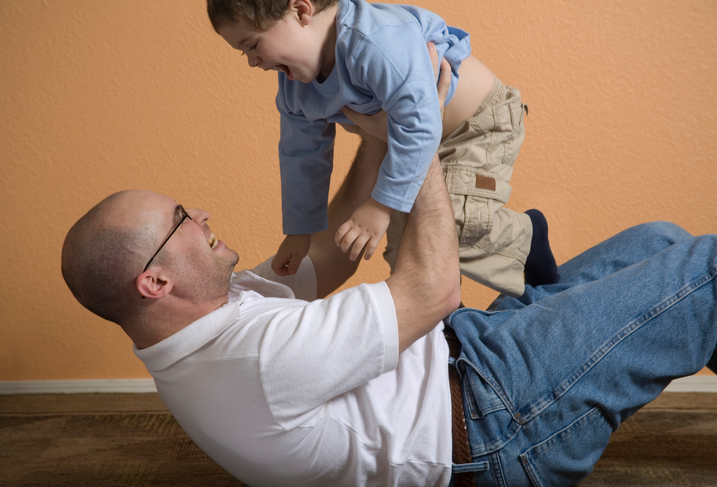
Playing together is an almost magical way to build connection. Not surprising, since when we laugh, our body releases oxytocin into our systems. So when you're laughing with someone, you're bonding. Laughter also transforms bad moods by decreasing the stress hormones circulating in your body.
That's why playing together is one of the fastest ways to heal minor relationship stress, help people drop grudges, and bring the family into sync. Play and laughter create a happy feeling in your home.
Research shows that humor is an invaluable part of smoothing over the rough spots of life, from royal goofs on our part to simple bad luck. Couples who can use affectionate humor to deflate anger have happier relationships. And children whose parents use silliness to keep the day flowing smoothly are lucky indeed. Sometimes it's the only way to convince a toddler or preschooler to cooperate with your agenda.
In fact, some parents say that unless they make instructions to their younger kids into a game, their children are so engrossed in play that don't even notice them.
Instead of:
"Eat your breakfast now!"
why not try:
"Little Gorilla, it's time for breakfast, come eat your bugs and bananas!"
Instead of:
"Get in the car!"
why not try:
"Don't you think your steam shovel wants to get in the car now so he can see the construction site on the way to school?"
Given how hard life can be at times, my opinion is that we need to seize all the joy, silliness, fun and humor we can get.
The best way to start cultivating more playful fun in your house is to make it part of your routine. You can do this by simply trying new ideas, and if they work, repeating them. That creates fun traditions for your family to enjoy and look forward to. Not all rituals need to be serious or spiritually joyous, some of the best are silly. But don't wait for special times; any part of daily life can be made into a game.
For instance:
- Use funny voices.
- Trade roles at the dinner table so that each family member acts as someone else (kids’ portrayals of adults can be hilarious).
- Have a race to get dressed and in bed for storytime. Instead of kids racing against each other, which worsens sibling rivalry, have kids work
as a team, racing against the adult or the clock.
- Compete at making baskets with the dirty laundry while doing household cleanup together.
- Make up funny song lyrics in the car.
- With some kids, gentle physical rough housing as they wake up in the morning puts them in a good mood for the day. My own personal favorite
is a competition to take off each other’s socks!
- And when you're feeling a bit dispirited and want to shift the mood and reconnect, why not start a pillow fight?
A few caveats for games:
1. Don’t make light of serious situations or emotions.
Start by empathizing. Don't try to talk her out of her feelings. But once she's vented, getting her laughing about the situation may be the most healing thing you can do. When she’s gotten past her upset over how unfair her science teacher was today, you can start to act out how YOU would have handled things -- by messing up totally --- or you might even be able to mildly mimic the science teacher, if you think it’s appropriate.
2. Be sure opponents are well matched.
This can be accomplished by handicapping adults and older siblings, for instance.
3. Be sure the environment is safe.
Needless to say, a family tickle match where there are breakables or sharp objects is almost guaranteed to end in disaster.
4. Competition in itself is not bad, but valuing winning above the game is.
For many children -- and even some fathers and sons -- noncompetitive games work best.
5. What if someone gets hurt?
Often, kids do begin to cry when they get a big bump while roughhousing. Sometimes those tears are appropriate to the injury, and your child is ready to get back into the action after a quick hug from you.
Sometimes, though, kids sob wildly, clearly over-reacting. That's a good thing! No, really. It means all that laughter has loosened up the feelings stuffed in their emotional backpack, and they're taking advantage of this owie to share the deeper wounds they can't verbalize. After a good cry, your child will be so much more relaxed and happy, since those emotions will be released from their "emotional backpack."
So instead of feeling like a bad parent because someone got hurt, relax. Take the opportunity to help your child with his big feelings, and be grateful he got a chance to cry. Afterward, ask both kids if they think they need to add any new rules to keep everyone safer next time. Then, write the rules down and post them, so you can easily remind them next time they start getting wild. (Written agreements have extra power even for kids who can't read.)
Click here for more on Roughhousing.
"Play is children's main way of communicating. .... Playing is connection. ... Boys especially need empathy and emotional connection. You can't communicate to them that what they want to play is stupid and violent and antisocial, and then expect them to talk to you about their inner feelings."
-Lawrence Cohen, Playful Parenting
More Game Ideas*:
“Relay-Race” Jammies
A child takes off one piece of clothing, runs to another room, and touches a certain spot; then runs back, takes off the next item or puts on the next bed-time item, and then repeats until dressed. This gets out the evening energy and takes the focus off of “getting ready for bed.” Be sure to follow with a calming activity such as reading bedtime stories.
Airplane
This is a great solution to seatbelt wars and can get you out the door on time, without a struggle. Pretend you are going on an airplane. Start by playing the flight attendant, saying, "Flight 1234 will begin boarding in 5 minutes. Please collect your baggage and proceed to the gate.“ And, later, “All ticketed passengers should now be on board.” Once in the "airplane" the flight attendant asks all passengers to make sure their seatbelts are buckled "low and tight across their laps," etc. You can "prepare for takeoff" on the driveway and off you fly.
Code FUN!
“Code FUN!” is only used when you’re in a rush; this keeps the preparations fun. Either the child or parent "rings the bell" to signal that it's time to rush. Then see how fast the kids can get into their clothes, or get into the car to leave. Only use this one when you are almost ready to go (no-one stops to run the dishwasher in an emergency!) and make sure that everyone knows the difference between this and a real emergency.
Surprise Me
My son invented this game. The parent expresses doubt that the child is able to do something easy and then acts surprised when it happens. Use this one only if it gets your child giggling so you know they are in on the game and so as not to use it manipulatively. A variation of this is to act surprised that something has changed, e.g., "Now how did that plate get from the table to the counter?”
Time-It
Run a stopwatch to see how long it takes your children to do a task, e..g, cleaning up all the toys. Instead of comparing to last time, just say, "Wow—3 minutes and 9 seconds!” Or, agree to see how many toys you can pick up together in a certain amount of time or until a particular piece of music ends. When the timer goes off, you’re done picking up, even if some toys are still left. Make sure that the tasks are short enough that your kids can stay focused and engaged. Both of these games help kids gain a sense of time and responsibility.
Let's Race!
This is a great game for getting dressed. Race your child to see who gets dressed first, or let him try to get dressed before you finish something, such as making breakfast. When more than one child is involved, have the children team up and help each other.
The "Can-Do Team"
This idea came from a working mom with three children. When her husband travels, it's hard to get all three kids out the door, dinner made, everyone to bed, etc. The idea is to tell your kids, "We can do it together, because we're a 'Can-Do Team!” Let your kids help each other get dressed, brush teeth, get breakfast, pack backpacks, and load the car while you cheer them on. Encourage each of them to communicate with each other to figure out when and where help is needed. Everything is a team effort with all parties sharing ideas and suggestions on how to get something done. When something breaks down, everyone stops what they're doing and problem-solves the breakdown. You might even have them pick an actual team name ("Fireballs," "Eagles," "Howling Wolves," or…) "Can-Do Team, let's make dinner! What are we having?” (Let them create a menu). “Can-Do team, who's setting the table? Ready?!? Go!"
Top-to-Bottom Cleanup
Have you ever noticed how it is more fun to do someone else's work than your own? In this game, work together to clean the house, without attention to who made the mess. Take a laundry basket with you to put items that belong in other rooms, and ask your child to "drive" it from room to room, putting things away as you travel. Use your imagination – e.g., the laundry basket can be a dumptruck and the vacuum can be a bulldozer. This game also offers an opportunity to talk about how nice it feels when rooms are clean and how great it feels to work together.
* Thanks to Parenting Facilitator and Coach Lisa Stroyan, who suggested these games when I interviewed her for my radio show years ago!
Don't Miss:
Playing with Your Child: Games for Connection & Emotional Intelligence»