
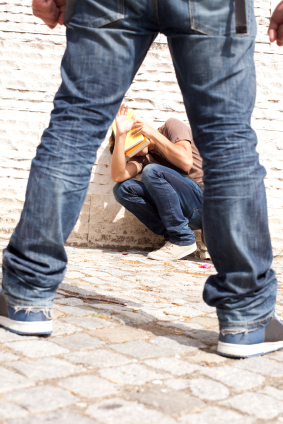
Why would a young person do such a cruel thing? Because it gives her power. We all need to feel powerful in our lives. If we don't have access to power in healthy ways, it can be hard to resist using it in unhealthy ways. And for a child or teen who often feels powerless in her life, abusing power by bullying can feel as potent as a drug.
If someone has humiliated, threatened, or hurt him, those feelings often threaten to overwhelm his psyche, and he lashes out, wanting to humiliate, threaten or hurt someone else. If he's hurting inside, bullying someone else can help him feel a little better for a short time. Unfortunately, then, kids who are hurting often hurt other kids.
Can you bully-proof your child? Unfortunately, no. There have always been hurting people who act out by hurting others, and your child's path will sometimes cross with theirs. And all children want to get their way, which means they will sometimes abuse power; that's developmentally normal and short-lived in a context where they're also developing empathy. Your goal is not to insulate your child, but to support him to develop the awareness and skills to protect himself when necessary, and to seek help when he's in over his head.
Bullying behavior begins in preschool and gains momentum as kids grow. Depending on which survey you read, between 40 and 80 percent of middle schoolers admit to participating in bullying behavior, so clearly our culture bears some responsibility for the pervasiveness of bullying. Many kids describe themselves as having been subjected to bullying but also as having bullied others. For this reason,
Restorative justice circles, conflict resolution training and transforming the culture of a school have all been proven to be more effective approaches to reduce bullying than targeting bullies with punitive punishment.
Unfortunately, our school cultures are still struggling to implement effective approaches, and the situation is getting worse in many communities. The interaction of bullying and social media seems to have increased the psychological danger, so that kids feel they don't have a safe refuge, and more teens and even middle schoolers are committing suicide in response to bullying. Recent research shows that long-term consequences of bullying include higher risk for depression, anxiety, PTSD, substance abuse and self-destructive behavior.
That's the bad news. The good news is that you can help your child develop the skills to stand up to bullying behavior, and you can keep him from becoming a bully. How?
1. Model compassionate, respectful relationships from the time your child is small.
As Alice Miller, author of Thou Shalt Not Be Aware, wrote: "If children have been accustomed from the start to having their world respected, they will have no trouble later in life recognizing disrespect directed against them in any form and will rebel against it on their own."
The most effective way to keep children from being bullied, and from becoming bullies, is to make sure they grow up in loving, respectful relationships, rather than relationships that use power or force to control them. Children learn both sides of every relationship, and they can act either one.
If you spank, your child will learn that physical violence is the way to respond to interpersonal problems. Research has repeatedly established that physically disciplining a child is associated with more bullying behaviors.
In fact, any discipline methods that use power over a child teach him to use power over others, or to let others use power over him. Punishment is often perceived by children as adults using force to get their way, which teaches them that bullying is okay. Don't worry, you don't need that kind of discipline. For compassionate discipline that works, see the section on Peaceful Discipline on this website.
2. Stay connected to your child through thick and thin.
Lonely kids are more likely to be bullied. And kids are often ashamed that they're being bullied, so they are hesitant to tell their parents. If your child knows that you will always listen, and that you have their back, they are more likely to talk with you about things that upset them.
How do you make sure that your child would tell you if they were being bullied? Remember, parenting is 80% connection -- a close relationship with your child -- and only 20% guidance. The guidance won't stick unless you have the relationship to support it, and will just drive your child away. So prioritize your relationship with your child, and keep those lines of communication open, no matter what.
3. Model confident, respectful behavior with other people.
If you lose your temper and curse out other drivers, even from the privacy of your own car, you're teaching your child that sometimes it's okay to disrespect other people. Conversely, if you tend to back down easily so you don't make a scene, but then later feel pushed-around, it's time to change that. Your child is learning from watching you. Experiment with finding ways to assert your own needs or rights while maintaining respect for the other person, and model treating everyone with respect, even when you disagree.
4. Directly teach your child respectful self-assertion.
Kids need to know they can get their needs met while being respectful of other people. Give him words to stick up for himself early on:
- "It's my turn now."
- "Hey, stop that."
- "Hands off my body."
- "It's not okay to hurt."
- "I don't like being called that. I want you to call me by my name."
5. Teach your child basic social skills.
Unfortunately, bullies prey on kids whom they perceive to be vulnerable. If you have a child who has social-skill challenges, make it a priority to support your child in all the other ways listed in this article, to make him less attractive to bullies. Then, make games out of social skills, and practice at home. Role play with your child how to join a game at the playground, introduce himself to another child at a party, or initiate a playdate. For instance, kids who are successful in joining groups of kids usually observe first, and find a way to fit into the group, rather than just barging in.
Sometimes kids want peer acceptance so much that they continue to hang around a group of peers even when one of the group leaders begins to mistreat them. If you suspect your child might be vulnerable, listen to what he says about peer interactions to help him learn to check in with his own inner wisdom, and work to provide healthy relationship opportunities for him.
6. Teach your child how the dynamics of bullying work.
Research shows that bullies begin with verbal harassment. How the "victim" responds to the first verbal aggression determines whether the bully continues to target this particular child. If the aggression gives the bully what he's looking for -- a feeling of power from successfully pushing the other child's buttons -- the aggression will generally escalate. It's imperative to discuss this issue with every child BEFORE they might be subject to bullying, so they can stand up for themselves successfully when a bully first "tests" them.
7. Practice with roleplays so that your child feels comfortable responding to teasing and provocations.
Roleplay with your child how he can stand up to a bully. Point out to your child that the bully wants to provoke a response that makes the bully feel powerful, so showing emotion and fighting back are exactly what the bully feeds off. Explain that while your child can't control the bully, he can always control his own response. So in every interaction, how he responds will either inflame the situation or defuse it. Your child needs to avoid getting "hooked" no matter how mad the bully makes him.
The best strategy is always to maintain one's own dignity, and to let the "bully" maintain his dignity -- in other words, to keep your dignity while withdrawing from the situation, and not to attack or demean the other person. To do this, simply say something calm like:
- "You know, I’m just going to ignore that comment."
- "I think I have something else to do right now."
- "No thank you."
Then, just walk away.
Teach your child to count to ten to stay calm, look the bully in the eye, and say one of these things. Practice until your child has a strong, self-assured tone.
8. When your child first begins to use technology, teach, supervise, and stay involved.
Bullying on Social Media is not so different from bullying in person; it is still an abuse of power. But there are some differences. Kids who wouldn't be likely to engage in unkindness to someone's face may be able to ignore the impact of their actions online, and thus may find it harder to resist bullying. When your child first begins to use social media, review it with them daily. Keep an attitude of curiosity, support and humor. Ask your child how they felt about their various interactions, what was hard, how they decided what to do. Children develop good judgment from interactions where they have a chance to safely reflect on the choices they made, and what happened.
To prevent online bullying, teach kids:
- Never share your passwords, no matter what.
- Review privacy settings regularly with your parents.
- Do not share anything that could hurt or embarrass anyone.
- Never forward anything that could be hurtful.
- Being kind to others online will help to keep you safe.
- Remember that being mean online or forwarding hurtful messages is just like being mean or spreading hurtful rumors or embarrassing someone in person.
- Always come to an adult if something online makes you uncomfortable.
The good news about bullying via technology is that you have a record. So if your child does get bullied online:
- Document everything with screenshots and dates.
- Block the person.
- Report it to the school, with documentation.
For more on teaching kids to take care of themselves online, see: Cyber Smarts: Keeping Your Child Safe Online
9. Teach your child that there is no shame in being frightened by a bully, in walking away, or in telling an adult and asking for help.
Bullying situations can escalate, and saving face is less important than staying safe.
10. Teach kids to intervene to prevent bullying when they see it.
Bullying expert Michele Borba says that when bystanders -- kids who are nearby -- intervene correctly, studies find they can stop bullying more than half the time and within 10 seconds.
The best interventions:
Partner with the victim and remove her from danger - Go stand with the victim physically, turn the victim away from the bully and walk her off in the other direction -- towards adult help. Say "You look upset" or "I've been looking for you" or "The teacher sent me to find you."
Get help - Bullies love an audience. Get the other kids on your side by waving them over to you, yelling, "We need your help." Confront the bully: "You're being mean." Then walk away: "C'mon, let's go!"
And of course, if you're at all worried about safety, shout for a teacher or dial 911 on a cell phone.
11. Teach your child basic bully avoidance.
Bullies operate where adults aren't present, so if your child has been bullied, she should avoid unsupervised hallways, bathrooms, and areas of the playground. Sitting in the front of the school bus, standing in the front of the line, and sitting at a lunch table near the cafeteria chaperones are all good strategies for bully avoidance.
12. Don't hesitate to intervene.
Your job as the parent is to protect your child. That means that in addition to teaching your child to stick up for herself, you may well need to call the teacher or principal. Don't give your child the message that she's all alone to handle this. And don't assume that if there isn't physical violence, she isn't being wounded in a deep way. Despite the old rhyme about words not hurting, mean words and isolation are terribly damaging to a child or teen's psyche, and research shows they can cause lasting negative effects. If the school cannot protect your child, consider transferring to a different school, or even homeschooling.
Strategies for Kids to Fend Off Bullying
Talking with Teens and Preteens about Bullying
Using Play to Help a Child Who Has Been Bullied, Bossed
Additional Resources
Parents often ask me for good books to read that address bullying. Here are some suggestions both for you and your child.
For Parents:


For Children:


For social skills, I also recommend Lonnie Michelle's How Kids Make Friends: Secrets for Making Lots of Friends, No Matter How Shy You Are (link below).

For Schools: