
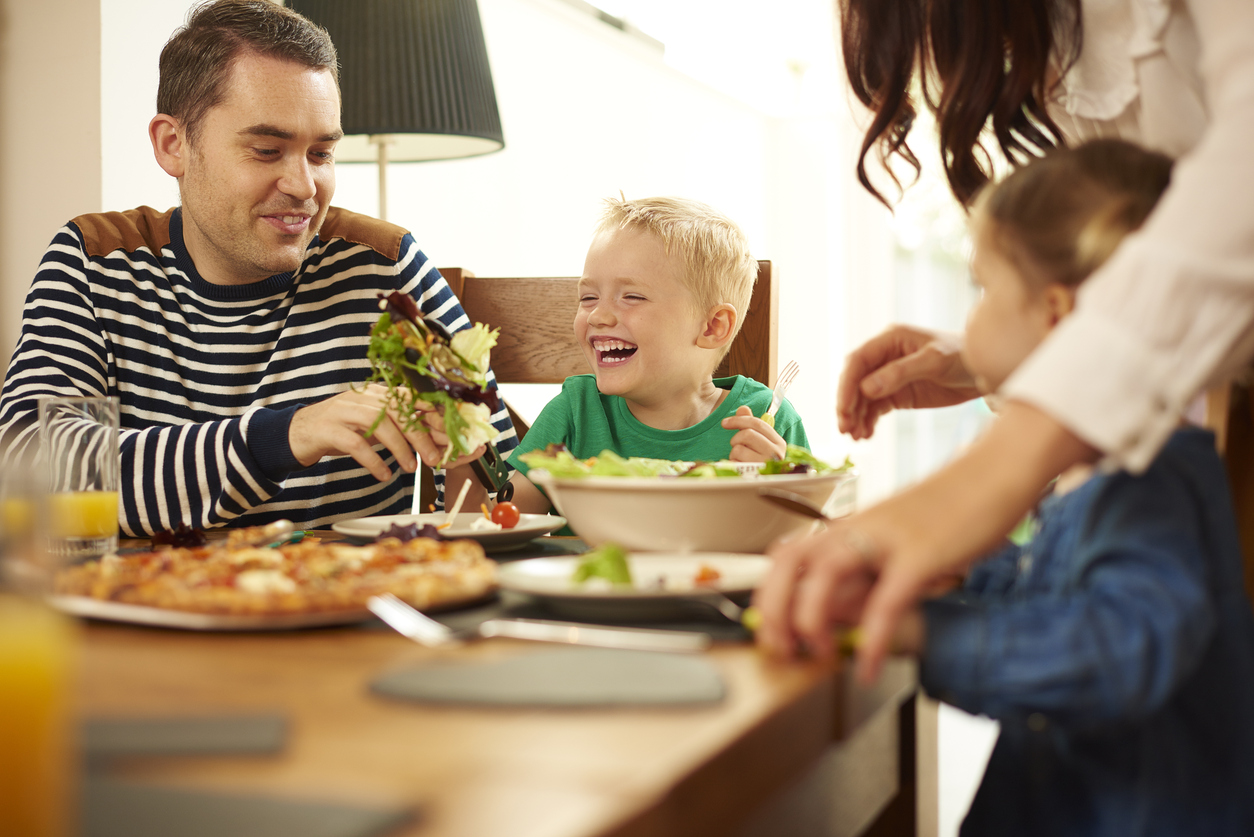
You’ve probably heard that having dinner together as a family is a good thing for your kids, but you may not realize that it could change your child’s life. Dinner is the best predictor we have of how kids will do in adolescence. The more frequently kids eat dinner with their families, the better they do in school, and the less likely they are to get involved with drugs or alcohol, suffer depression, consider suicide, or become sexually active during high school.
Why?
- Maybe because families who eat together talk more, which helps them stay connected and build better relationships.
- Maybe because parents who show up to eat with their kids are more likely to express their love constructively in other ways, too, in the form of both attention and supervision.
- Maybe because families who offer kids more structure are more likely to keep kids attending to their homework as well as out of trouble.
- Maybe because dinner transforms individual family members into a "group," which gives parents more clout to rival the power of the peer group.
- Or maybe because children, even more than the rest of us, need something to count on every day, the tangible security of belonging and being nurtured that is represented by the ritual of sharing food with those we love.
Whatever the reason, dinner is a pretty easy insurance policy to build into your home life. If you’re too busy to have dinner as a family on a regular basis, it's worth re-examining why, given how important it is.
"What's a regular basis?"
The research shows that the more meals together, the better, meaning that two is much better than none, and four is much better than two. Obviously, it's ideal if both parents -- when they live together -- can have dinner with their kids every night. But we don't live in an ideal world, and by definition no human is an ideal parent. So we do what we can, which can often mean one parent holding down the fort at many weeknight dinners. That gives Friday, Saturday and Sunday a celebratory tone as everyone sits down to savor the meal together.
"I eat with the kids every night, but my husband can't get home till later. Does that matter?"
Sometimes that's the best a family can do during the week, and you make it work. But it becomes all the more important that the whole family have time together on the weekend. There’s something magical for building family identity when all members of a household share meals together, at least some of the time.
"What about kids' sports schedules that keep them away at dinner?"
Once a week of dinners on the run is inconsequential, but if conflicting schedules mean your family can't sit down at least a few times during the week for dinner, it's worth some creative thinking. Can the schedule be changed so that you all eat earlier or later? Can a child switch to after-school rather than evening activities? Can you all at least gather together for fruit and milk or herbal tea before bedtime so that you get some family time that evening?
"We eat together, but we eat in front of the TV. Does that count?"
Does it make you feel more connected to your family? Not as much as a conversation, I suspect, so the short answer is No. It's challenging to make dinner fun and relaxing when everyone is pressured and tired, so it can be a lot easier to turn on a screen at the end of a long day than to interact with your kids. But eating in front of a screen builds your relationship with the screen, not with each other.
"I'm so wiped out at the end of the day that I don't have the energy to make dinner into anything special."
After work and sports schedules, parental exhaustion is the single biggest obstacle to family dinners. But this should be a time for everyone in
the family to recharge and reconnect, including you.
The first secret is to minimize the cooking -- remember, the food is not the point. (See #3 below.) The second secret is to nurture yourself as well as your kids, not just in the evening, but throughout your day.
We lose an important opportunity to check in with our kids and and re-connect if we lose dinner, especially if we work away from them all day. Dinner is so important as a foundation for family culture that I urge you to think of it as a cherished family tradition, and skimp somewhere else if you have to.
"What about date night?"
While your kids are young, you may want to sit down with them for Saturday night dinner before the babysitter arrives and you head out for an evening with your partner. Consider this first part of your Saturday evening "date night" with your kids, and make it festive. Of course, if you have dinner as a family most of the other nights of the week, this won't feel necessary.
"As my kids have gotten older, they don't want to have dinner with us on the weekend."
Again, if you have dinner as a family most other nights, you can feel comfortable exempting Saturday night as "party night" for everyone. But if you don't, then your family needs the connection time -- even if your tweens and teens don't know that!
Naturally, as your kids get older, they'll be the ones having date night. But if you open your doors to your kids' friends for dinner, tweens and even teens often enjoy a delicious free, home-cooked dinner -- and are willing to engage in an interesting discussion, if you don't embarrass them -- before they head out to a movie or party. That may seem hard to believe, but my children’s friends have commented that they love hanging out at our house because the conversations are always so interesting. With some discussion ideas in mind and a little energy, you can create a dinner hour that will have the teens almost wishing they didn’t have to head out. (I said almost.)
How do you create a dinner hour that's so nurturing that everyone in the family -- including you -- looks forward to it? Here are the basics to get you started.
1. Put on your own oxygen mask first.
If you walk in the door from work exhausted and have to rush to get dinner on the table, you won't have any internal resources left by the time you sit down. Try putting out healthy snacks (carrots and hummus, cheese and crackers) as the "first course" while you take ten minutes to wind down. After that, you'll be more relaxed while you get dinner on the table and sit down with those people you adore. For more tips, see Surviving Arsenic Hour.
2. Consciously cultivate sacred space.
There’s nothing magical about exhausted parents, cranky kids, and take-out food. But with minimal effort, we can create a daily, short but restorative, celebration of family, which offers refuge from the trials and tribulations of ordinary life. Some families do this by lighting candles, which seems to set the time apart and make it special. Some say a short blessing, which may or may not be religious in nature, but reconnects us with our gratitude for simply being alive and together.
The most important component, though, is the attitude of celebration and appreciation. Parents will need to set the tone by overlooking trivial issues like table manners and whose turn it is to (fill in the blank), and focusing instead on what really matters. Which isn’t, by the way, the food.
3. The food is not the point.
I'm considered a health food nut by my family, and not a day goes by without my urging more vegetables on them. But I try to remember that the point of sitting down to dinner is to connect with each other, not what we eat. I never knock myself out with an elaborate meal on a weeknight when it's just our family eating. There are plenty of easy, healthy, kid-pleasing options out there, and my advice would be to eat simple, and save your energy for making the dinner table pleasant, rather than cooking a meal that leaves you even more exhausted at the end of a long day.
How simple can you eat? Your call, and my admiration to the chefs out there, but I rely heavily on meals like spaghetti with sauce from a jar and salad from a bag (ok, cut up some red pepper and cucumbers), tacos, leftover grains with frozen peas and grated cheese, organic chili from a box (accompanying healthy corn muffins from a mix always makes this a crowd-pleaser), and scrambled eggs with raw carrots out of the bag. Make soup on the weekend and eat it on Monday and Wednesday. And of course, there's always pizza and take-out. The point is that decent nutrition does not require a long prep time, and stressing about the food sabotages what you really want, which is connection with your family.
4. Turn off the TV and radio; put away phones.
Some families resist the temptation to turn on the TV during dinner by situating the TV where it can’t be seen from the table. Many impose a rule that no one answers phone calls, even if Mom or Dad gets an important work call, and turn off cell phones so they can't be heard. Protect this special time with your family from interruptions. As a previous U.S. President said about prioritizing dinner with his daughters, the world will still be there in half an hour, even if you're the President.
5. Establish fun rituals and routines.
Some families take turns choosing appropriate background music or being in charge of dessert. Some rotate who says the blessing or chooses the discussion topic. In some families, Tuesday is pizza night and Friday is family game night or the Jewish Sabbath. It’s the fact that you always do the same thing that reinforces the ritual aspect, and creates the feeling that this is home, and family, and regardless of the day’s difficulties, life is good.
6. Use blessings to create a sense of gratitude and connection.
For some parents, saying grace is a time-honored tradition they wouldn't think of overlooking; for others it feels foreign and artificial.
I often hear "I don't believe in God, so we don't say blessings at dinner!" But blessings are not necessarily about God. Blessings are about us: our gratitude that we are able to sit down to a meal when others are hungry, our appreciation of each other, our honoring the person who prepared the meal and the bounty of nature that produced it, our awareness that in this moment we have everything we truly need. Blessings don't have to be traditional prayers to "God." Blessings are a way of marking the meal as a sacred time together, a way of connecting us together in the deliciousness of shared appreciation. You might try holding hands while each person says one thing they're thankful for. Meg J. Ryan's book A Grateful Heart: Daily Blessings for the Evening Meal from Buddha to the Beatles has blessings of all kinds if you want some inspiration.
7. Make the discussion interesting for everyone,
rather than just adults talking about their jobs. Some families rule job talk off-limits, but I personally think there’s much for kids to learn by hearing sometimes about their parents’ days as well as their own. You might start with a quick check-in round of “So how was school/work today?,” which often leads into a topic. Many families like a slightly longer version, such as "Rose and Thorn" in which each family member shares the best and worst of their day. You can even do "Rose, Thorn and Bud," where "Bud" is something that is just beginning for you, or that you are looking forward to.
You might then explore something that was raised in the check-in (“Alice said she has to choose her Science Fair Project. What are you considering? How will you make the decision?”)
or talk about an upcoming family decision, such as what to do during the school spring break. Ask kids their opinions on the issues of the
day, or ask them for input on a decision you have to make. Pose ethical problems that don’t have easy answers and let different family members
consider how they might approach them and why. Share a poem you stumbled onto today, or a mistake you made, or a decision you have to make.
Jokes can be fun, but be careful, because kids' humor can easily degenerate into a dinner you won't enjoy.
8. But what do we talk about?
Write possible agenda items on index cards and put them in a kitchen drawer, so if you're just too tired to think you can still have a rewarding and re-energizing discussion by just pulling out a topic. Some ideas:
- Name five reasons you’re glad to be alive.
- What did you most enjoy today?
- Did anything scare you today?
- Did anything challenging happen that you had to be resilient to handle? What inner resources did you use? What outer resources did you mobilize? What did you learn?
- Tell each person in the family why you’re glad they’re part of the family.
- What’s the best thing about our family?
- What do you think makes a happy family?
9. Listen.
Middle School teacher Michelle Trujillo, in her book Why Can't We Talk? What Teens Would Share if Parents Would Listen, says that tweens and teens want desperately to talk to their parents about things that are worrying them, but parents don't listen, or jump in to solve problems.
If someone at the table raises something challenging, don't expect to solve it immediately. Listen. It's fine to ask "How can we help?" but don't jump in to solve the problem. Instead, listen, commiserate, empathize. Don’t offer advice unless asked, and your kids will be more willing to bring up what’s bothering them. Kids often gain insight into solutions just by talking.
Your kids won't always say things in ways that are easy for you to hear, but try to see it from their perspective. Bite your tongue or cover your mouth (literally, if you're like me) if you need to, so that you don't interrupt, and hear them out. Breathe deeply so you stay calm.
If a topic feels inappropriate for the dinner table, thank the person who brought it up, and ask if you can talk about it more after dinner, privately. Just keep reminding yourself how lucky you are to have kids who are willing to talk with you, and breathe!
10. Make sure everyone participates.
Families who have already created a culture of discussion will have an easier time with this than those who introduce it to older kids, but don't give up. Kids who don't speak up can often be coaxed to talk by asking them specific questions about their interests. "What makes rap music special to you?" will be more effective than "How was school today?"
Closed-mouth teens whose families haven't made a habit of dinner table conversation may take special wooing. Be prepared for some wise-cracking ("The most interesting thing about me is how corny my family can be!") and keep your sense of humor, and your teen will probably engage on his or her own terms. Facilitating a positive discussion can be a challenge for parents, but is infinitely worth it for the communication and closeness it fosters in your family.
11. Protect the dinner table as a nurturing, happy, safe space.
Defer unpleasant topics. Kids who begin to squabble can be asked to come up with five things they appreciate about the sibling with whom they’re fighting. Adults who start to complain about their day can be asked to add "and my life is blessed" to any complaint and fined a dollar toward ice cream cones on Sunday evening. If you've tolerated a family culture where teasing is allowed -- which seems to be the norm among many families with teenage boys -- proclaim the dinner table a safe space exempt from comments that hurt another's feelings. (You might also want to re-examine the role of teasing in your household culture to make sure it's benign; click here for more info on creating a nurturing and safe emotional space for your kids.) The key is cheerful, relaxed, and kind parental leadership so that everyone's contribution is valued and no one feels criticized.
12. Agree on which nights you will all eat together and make it a big deal to miss those nights.
Most families can’t eat together every night. Sometimes an adult is out of town, or a child has a school event. Some parents try to keep one night as date night to keep their bond with each other fresh, and many families routinely socialize on Saturday nights or have Sunday dinner with extended family. But you can create the expectation that on certain nights, everyone comes home for dinner. Start small, if you need to, with one or two nights a week. Even those limited by a long commute or odd hours can often manage a night or two, and those nights become extra-special for everyone.
13. Play with your food.
Or at least play with your family while you’re eating your food. Creating a sense of fun and play at the dinner table is the single best way to make everyone look forward to that time together, and sets a wonderful tone in your house. Laughter really is the best medicine after a grueling day.
How? Impersonate each other. Talk in rhyme. Guess what each person’s mashed potato sculpture is. Make every comment refer to food (“I’m fried.” “Guess your day wasn’t a bowl of cherries?”) Have a joke contest, where everyone is required to bring a joke to the table, which once a week you add to your family jokebook.
14. Work toward having everyone help get the dinner onto the table and do the clean-up afterward.
There's no reason this can't be a fun, connecting part of your family life. We think of clean-up as a chore, but really it's a sacrament: the means by which this lovely time of connection and deliciousness can happen again next time!
Once children get used to the idea, the group effort can be fun, and of course it's a great learning experience for them. Most important, it changes the dynamic of one adult serving everyone else. Teenagers, especially, often enjoy the power of deciding what the family eats one night a week; learning to cook is good practice for when they go solo.
Obviously, this won't happen every night, and busy weeknights are the hardest because kids have homework, but you might want to talk as a family about whether everyone could help get dinner on the table one night a week to start. And you can start small, with everyone gathering to set the table together and get the food onto the table. In many families where only one person takes responsibility for cooking, that person is exempt from clearing and clean-up. For clean-up, rotate who's in charge of music, create a festive mood, and involve everyone.
15. Celebrate whenever possible.
Make a big deal out of birthdays, accomplishments of any kind, seasonal changes, and famous people’s birthdays (what a great opportunity to talk about why you admire Mahatma Ghandi, or Harriet Tubman.)
There’s always something to celebrate. Just making it through each day intact as a family is worth celebrating!
Recommended Resources